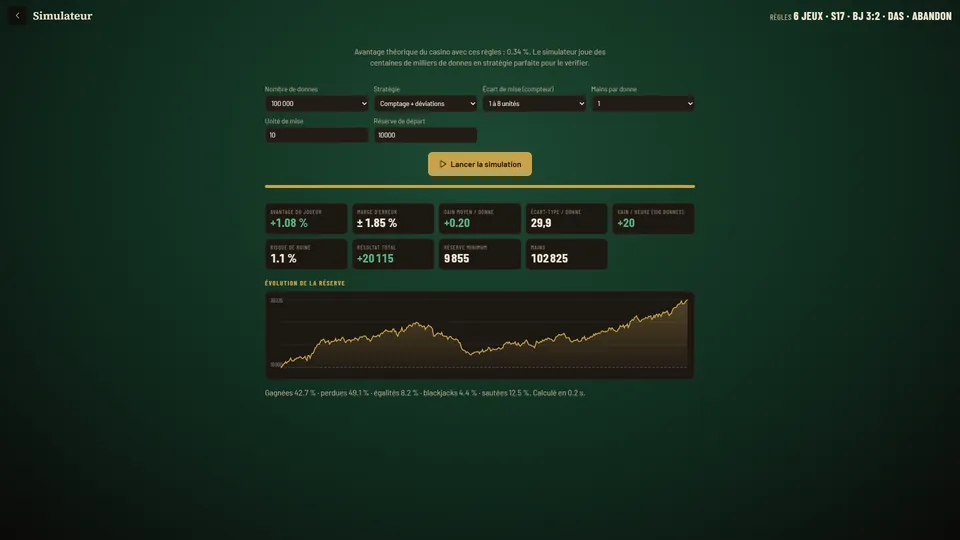
What the simulator measures
- Player edge (negative = house edge), with its margin of error.
- Average win per round and per hour (at 100 rounds an hour).
- Standard deviation: how big the swings are.
- Risk of ruin: the chance of losing your whole starting bankroll.
- Bankroll curve across the whole simulation.
Questions it answers
- How much does a 6:5 blackjack table cost you compared to 3:2?
- Does a dealer hitting soft 17 really matter?
- Does a Hi-Lo counter with a 1-to-8 spread make money? With what bankroll?
- How much do the Illustrious 18 add on top of the bet spread?
Reading the results
With the default rules (6 decks, S17, double after split, late surrender) and flat betting, the measured edge comes out around −0.4%: the casino keeps 40 cents per $100 wagered. Counting with a 1-to-8 spread pushes it slightly above zero, but the standard deviation shows how long the losing stretches can last.
Why you can trust it
The engine running the table is the same one the simulator uses: same rules, same shoe, same strategy. We validated it over 2 million rounds and the results match published reference values. Every result shows its margin of error; the more rounds, the smaller it gets.
Try it: default rules, then 6:5 blackjack. Compare.
Run a simulation