Why card counting works
In blackjack, cards that have been dealt don't go back into the shoe until the shuffle. When lots of small cards are gone, there are proportionally more tens and aces left. That favors the player: more 3-to-2 blackjacks, more successful doubles, more dealer busts. Counting tells you when that happens so you can bet more.
Step 1: the value of each card (Hi-Lo)
Small cards: +1. Middle cards: 0. Big cards: −1. A full deck adds up to exactly 0, which makes it a "balanced" system.
Step 2: the running count
Start at 0 after the shuffle and add the value of every card you see. Example: 5, king, 3, 2, ace, 6 gives +1 −1 +1 +1 −1 +1 = +2.
Pro tip: count cards in pairs. A ten and a four cancel out, so you skip them at a glance. Target: a full deck in under 25 seconds.
Step 3: the true count
A +6 at the start of a six-deck shoe is diluted across a lot of cards; near the end it carries real weight. So you divide the running count by the number of decks still to be dealt.
| Running count | Decks left | True count |
|---|---|---|
| +6 | 5 | +1 |
| +6 | 3 | +2 |
| +6 | 1.5 | +4 |
| −4 | 2 | −2 |
To estimate decks left, look at the height of the discard tray. In the game, the tray fills up at real scale so you get used to it.
Step 4: spreading your bets
Each point of true count adds roughly 0.5% to the player's edge, so the player moves ahead around +1. A classic 1-to-8 spread:
| True count | ≤ 0 | +1 | +2 | +3 | +4 or more |
|---|---|---|---|---|---|
| Bet (units) | 1 | 2 | 4 | 6 | 8 |
The resulting edge is small (around 0.5 to 1%) and the swings are huge: the simulator shows it takes tens of thousands of hands for the edge to show up.
Step 5: index plays (deviations)
Some decisions change with the true count. The most valuable ones: take insurance at +3, stand on 16 vs 10 at 0 or higher, stand on 15 vs 10 at +4, double 11 vs ace at +1, split tens vs 6 at +4 and vs 5 at +5. The full Illustrious 18 and Fab 4 list is in the guide.
Other counting systems
| System | Level | What's special |
|---|---|---|
| Hi-Lo | 1 | The standard, best place to start |
| KO (Knock-Out) | 1 | Unbalanced: no true count conversion |
| Hi-Opt I | 1 | Ace-neutral, often paired with a side ace count |
| Hi-Opt II, Omega II, Zen | 2 | More accurate, harder |
| Wong Halves | 3 | Half-point values, for experts |
| Red Seven | 1 | Hi-Lo plus red sevens, unbalanced |
All of them are available in the game (Settings → Counting).
Is card counting legal?
Counting in your head isn't illegal: it's just paying attention. Casinos can still refuse a player they suspect of counting, and any device at the table is prohibited. Here you practice with play chips: the goal is to understand the game, not to make money.
Practice, in order
- Deck countdown: speed and accuracy.
- True count conversion from the discard tray.
- Counting table: AI players, dealer quizzes, suggested bets.
- Index plays drill.
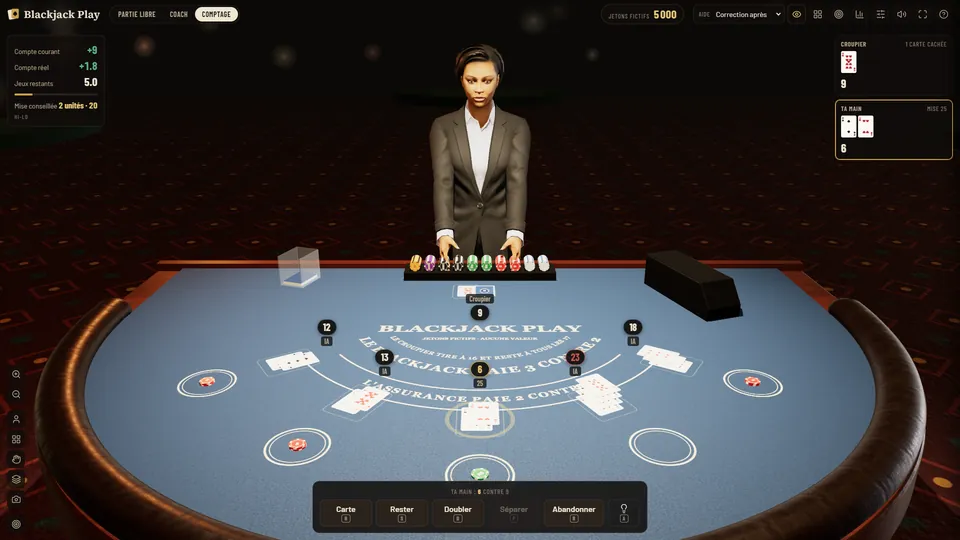
Ready to count for real, at a full table?
Counting table